
“A sprawling Odyssian epic that showcases war as a profoundly personal experience.”
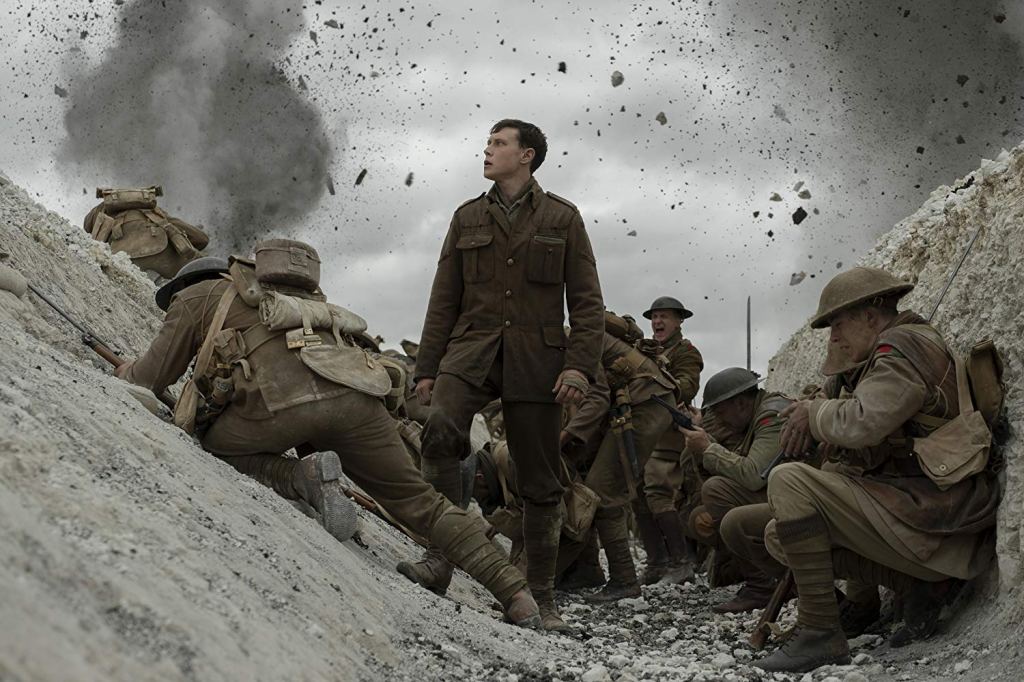
Sam Mendes, firmly back into the directors’ chair following a long holiday after Bond, tells his most personal story yet. Penning a script for the first time with the help of Krysty Wilson-Cairnes and directing with the eye of legendary cinematographer Roger Deakins, he creates a stunningly cinematic, moving and spiritual film.
1917 has a simple premise, two young soldiers in the latter half of World War One are tasked with delivering a vitally important letter across no-mans land in order to save 1600 men from near-certain death. In a lesser director’s hand, this could have been a generic war film, but Mendes takes this simple premise and elevates it to a sprawling Odyssian epic that showcases war as a profoundly personal experience. Expertly contrasting the large-scale chaos and destruction of war with the inner turmoil that comes as a result of the colossal psychological pressure.
As I’m sure you’ve read or seen by now, the film has been created as a “one take” experience, with clever, deceptive editing that gives the appearance of a singular, sustained two-hour shot. Although this novelty is often done as a means of showing-off, 1917 is a perfect combination of form and content. The one-take nature of the film enhances the narrative immersion in every way, as you follow the characters throughout their perilous journey, you can’t help but feel the same excruciating anxiety and claustrophobia that they feel. Even in calmer scenes, the unbroken take produces no relief from danger and when combined with the rich, emotional score, creates a dense atmosphere of tension that builds throughout the film and has you wanting to scream by the last 20 minutes.
Yet somehow, despite the journey guiding you throughout many desolate, war-torn landscapes, Deakins still manages to showcase an incredible amount of beauty through the lens. Sometimes the camera will be necessarily tight and the frame dense, other times it can pull back or ahead of the characters to reveal dream-like landscapes that seem almost impossible given the depravity of the events that have unfolded within them, a far cry from repetitive depictions of wet, muddy trenches than can plague other war films.
The lighting in the film, shifting from day to night and overground to underground, provides an exceptional variety of settings that further emphasise the immense journey the characters are forced into, as well reflecting the spiritual themes throughout. From towns engulfed in flames to serene bodies of water dotted with the bodies of men, every scene juxtaposes the beauty of the world with the horror of the war.
Mendes also employs visual tropes often used in horror, the fear and unease of not knowing what’s around the corner combined with the inevitability of having to find out, especially prevalent in darker scenes where the danger is entirely anonymous and the desperate panic can be felt through the screen.
Of course, the expertise behind the camera is paired with the talent in front, the two soldiers Schofield and Blake, fantastically acted by George MacKay and Dean Charles-Chapman respectively, are able to exude the huge range of emotions that go along with the complexities of war in a natural and naively youthful way. The equality of rank between the two allows for dynamic interactions where they can be independent of one another yet still function as a unit, which makes the deliberate path of the camera intelligently increase tension further during periods of separation. Goading the viewer into feeling somewhat comfortable with the presence of both soldiers can make any interspersions of independence uncomfortably isolating.
Other notable British actors are cast as officers throughout the film, and I found that going in without any prior knowledge of the roles created moments of surprise recognition. I could say that this ruined the immersion somewhat as I kept playing a guess-who of British greats, but on a more meta level, recognising these actors served a narrative purpose of providing welcome points of comfort. Seeing a familiar face as a viewer mirrors the reassurance felt by the characters upon seeing a senior authority figure.
Mendes also tactfully avoids the war cliché of “lions lead by sheep”. The authority figures in this film aren’t portrayed as incompetent villains, but as men shrouded in the fog of war, trying to do their best in a series of hellish events. Here, the characters are written realistically and the violence is not glorified. Instead, the focus is on the men, not the war, and the immeasurable costs that each is made to bear as a result.
1917 is written as a personal story, for both the characters and Mendes himself, the idea being based on a memory from his own grandfather who fought in the war. The memory was a vague recollection of a message being delivered across no mans land, but the striking image of one man surrounded by an inhabitable wasteland with an impossible task ahead was enough to spur him into making this film, and I’m glad it stayed with him. I wholeheartedly recommend going to watch this remarkable piece of cinema on the biggest screen you can find, provided your heart can withstand the tension.
 Film Class Heroes